


SHARPAL
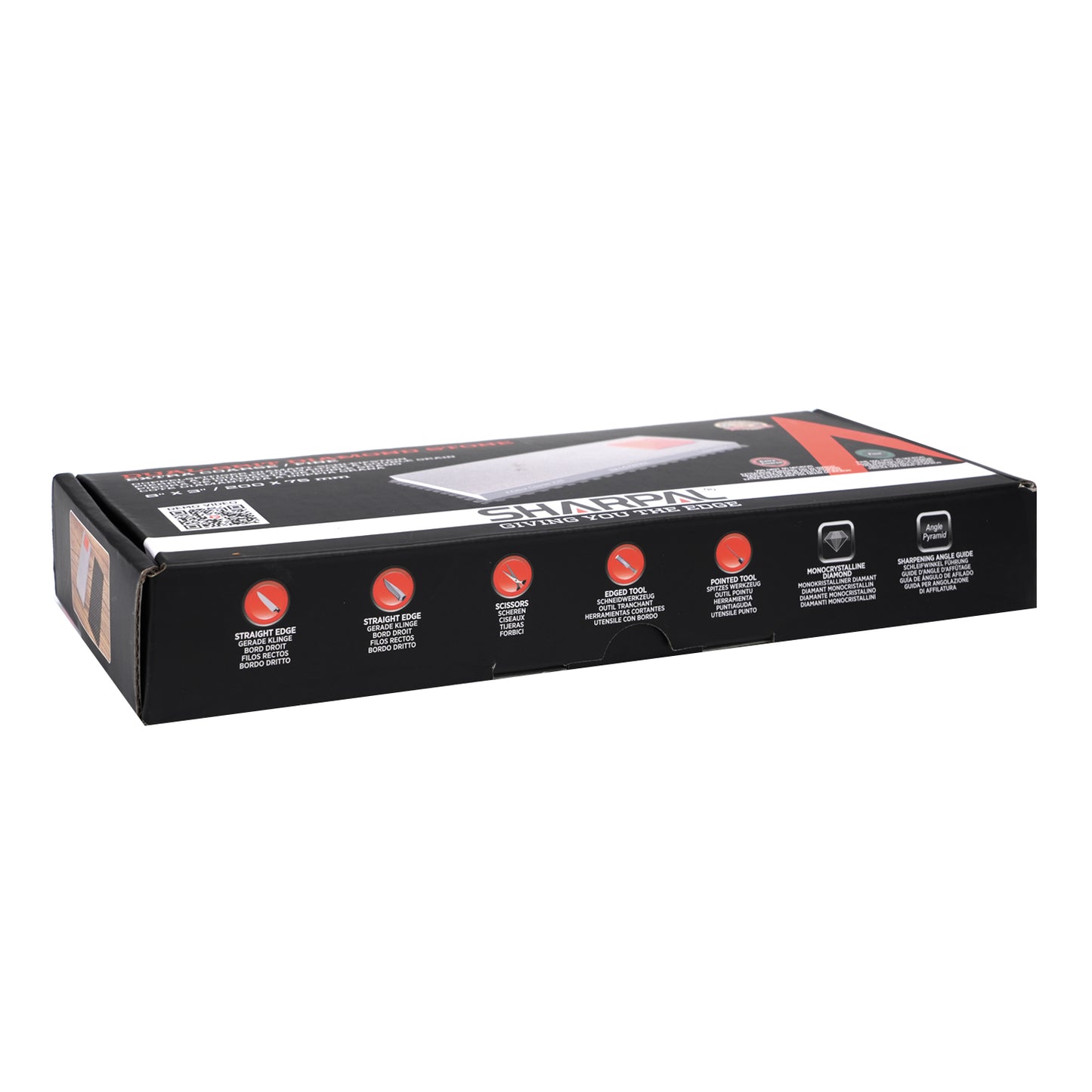
169H 8'' x 3'' Dual-Grit Diamond Sharpening Stone with Angle Guide (without storage case) Extra Coarse 220 grit & Fine 600 grit
169H 8'' x 3'' Dual-Grit Diamond Sharpening Stone with Angle Guide (without storage case) Extra Coarse 220 grit & Fine 600 grit
Couldn't load pickup availability




Instructional Video
FAQ
What grit does the SHARPAL 169H have?
The SHARPAL 169H has two diamond sharpening surfaces: 220 grit for heavy edge repair and 600 grit for sharpening and edge refinement.
When should I use the 220 grit side?
Use the 220 grit side for very dull, damaged, chipped, or worn edges. It removes material quickly, so it is best for edge repair, reprofiling, and heavy sharpening.
When should I use the 600 grit side?
Use the 600 grit side after the 220 grit side to refine the edge, or use it directly for general sharpening when the blade is not severely damaged.
Is 220 grit too coarse for kitchen knives?
For regular kitchen knife maintenance, 220 grit is usually too coarse. Use it only for damaged, chipped, or very dull edges. For normal maintenance, start with the 600 grit side or use the 168H 1000 grit side for finer finishing.
What is the difference between SHARPAL 168H and 169H?
The 168H uses 325/1000 grit and is better for regular sharpening, edge maintenance, and finer finishing. The 169H uses 220/600 grit and is better for heavy edge repair, faster material removal, and sharpening more damaged edges.
Should I buy the 168H, the 169H, or both?
Choose the 168H if you mainly need regular knife maintenance and finer edge refinement. Choose the 169H if you often repair dull, damaged, or chipped edges. Choose both if you want a complete progression from heavy repair to fine honing: 220, 325, 600, and 1000 grit.
What can the SHARPAL 168H / 169H sharpen?
They can sharpen kitchen knives, pocket knives, hunting knives, outdoor knives, and many tools, as long as the edge can be sharpened safely on a flat stone surface.
Should I use water or oil with the SHARPAL 168H / 169H?
Sharpen dry or with honing oil. Do not use water. After sharpening, clean off metal particles and keep the stone dry before storage.
Do these diamond stones need to be flattened?
No. The diamond plates stay flat and do not need regular flattening like traditional water stones. Their precision-ground flatness helps maintain consistent contact during sharpening.
Why are there dark marks on the diamond surface after use?
Dark marks are usually metal particles or sharpening residue left on the surface. This is normal and does not mean the diamond surface has worn off. Clean the surface after use and keep it dry before storage.
Is it normal to see scratches on the diamond surface?
Yes. Light scratches or dark marks are normal signs of use. They do not necessarily mean the diamond layer is damaged and usually do not affect sharpening performance.
Should I press hard when sharpening?
No. Use light, controlled pressure and let the diamond abrasive do the work. Excessive pressure can remove too much material and may shorten the life of the diamond surface.
How do I use the included Angle Pyramid® guide?
Place the Angle Pyramid® guide on one end of the sharpening stone and select the desired angle. Rest the blade on the guide to set the angle at the beginning, then sharpen across the stone while maintaining that angle. The guide does not move with the blade; use it to check your angle from time to time.
Common angles include 20° per side for pocket knives, 25° for hunting knives, 17° for fillet knives, 20° for European/American kitchen knives, and 14° or 17° for Asian kitchen knives.
Are the SHARPAL 168H / 169H suitable for beginners?
Yes. The large 8" × 3" surface gives more room for controlled strokes, and the included angle guide helps beginners keep a consistent angle.
Can I use a holder or storage base with the SHARPAL 168H / 169H?
Yes. The SHARPAL 160H storage base is designed to hold SHARPAL 168H, 169H, 162N, 204N, and 140H, and can also serve as a non-slip sharpening stone holder during use.
Can I use the 162N case as a sharpening holder for SHARPAL 168H / 169H?
Yes. SHARPAL 168H / 169H is about 0.08 in / 2 mm shorter than 162N. Place the included anti-slip pad on top of the holder to help prevent back-and-forth movement during sharpening.
Can the 162N case store one 162N and one 168H / 169H together?
Yes. Remove the foam from the bottom of the case and insert a physical separator between the stones to prevent direct contact.